


Blog

Most of us know what good posture looks like. The problem is that knowing has never fixed anyone’s slump. If you finish the day with a tight neck, aching shoulders or a sore lower back, and you catch yourself hunched over a screen ten times a day, the fix is not to “sit up straight” harder. It is a short daily routine that makes upright easy, plus a few changes to the chair, desk and habits that pull you out of line in the first place.
Key Points
- Bad posture is a habit held in place by tight muscles at the front of the body and weak ones at the back. Both can be changed at any age.
- The wall test takes 30 seconds and tells you which pattern you have: forward head, rounded shoulders, an over-arched or flattened lower back.
- Six exercises, ten minutes a day, cover the common patterns: chin tucks, wall angels, thoracic extension, doorway chest stretch, hip flexor stretch and glute bridges.
- The desk is where most posture is lost. Lumbar support, a monitor at eye level, feet flat and a break every 30 to 45 minutes remove most of the reasons to slouch.
- A posture brace is a reminder for short periods, not a substitute for strength. Wear it for 20 to 30 minutes, not all day.
- Posture that changed suddenly, is painful, or comes with numbness, weakness or pins and needles needs a professional, not a routine.
What is bad posture, and what does it do to your back?
Posture is simply the position your body settles into when you are not thinking about it. A healthy spine has three gentle curves, at the neck, the mid back and the lower back, and good posture keeps those curves in their natural range with the head balanced over the shoulders and the shoulders over the hips. Bad posture is any position that holds one of those curves out of range for long enough that the muscles and joints adapt to it. The classic pattern is the head drifting forward, the upper back rounding and the lower back either flattening into a slump or arching to compensate.
None of this is dangerous in itself, and the old idea that poor posture “causes” back pain is weaker than it sounds: plenty of people slouch without pain. What poor posture does reliably do is load the same tissues in the same way for hours, so the neck and shoulders tire, the mid back stiffens, and a sore lower back gets less recovery time. Fixing it rarely cures a back problem on its own, but it takes a constant, low-level strain off the spine, and for most desk workers that is the strain that matters.
What are the signs of poor posture?
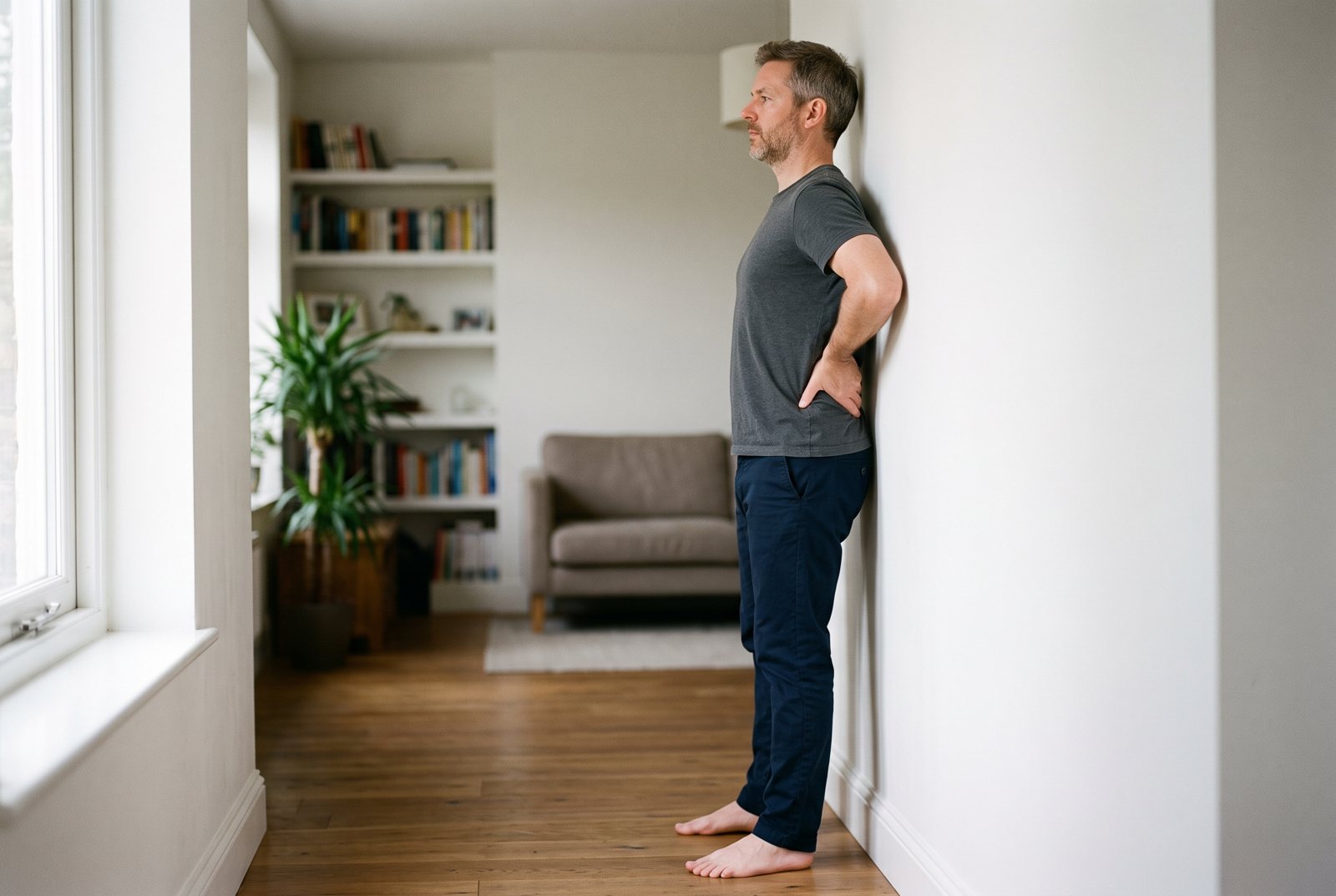
The quickest check is the wall test. Stand with your heels a few centimetres from a wall and let the back of your head, your shoulder blades and your buttocks touch it. Slide a hand behind your lower back: you should fit roughly one flat hand in the gap. If your head will not reach the wall without tilting your chin up, you have a forward head position. If the shoulder blades only touch when you force them back, the shoulders are rounded. If you can fit a fist or more behind the lower back, it is over-arched; if there is no gap at all, it has flattened.
Four signs show up most often: the head sitting in front of the shoulders, shoulders rolling forward, a lower back that either flattens or over-arches, and one hip or shoulder sitting higher than the other. The symptoms that usually travel with them are regular headaches, tightness across the top of the shoulders, stiffness through the mid back and a lower back that aches after a long sit rather than after activity.
Can you correct years of bad posture?
For the great majority of people, yes. Posture is held in place by soft tissue, and soft tissue adapts in both directions. Muscles that have been kept short lengthen when they are stretched regularly, and muscles that have switched off come back when they are asked to work. The exceptions are structural changes, such as an established curvature of the upper spine in older adults, which will not fully reverse but still respond to strength work with less pain and better function.
The honest timeline: two to three weeks of daily practice to feel a difference, six to twelve weeks to see one, and a habit that needs to continue at a lower dose after that. The people who fail usually stopped at week three because upright still felt like effort. It stops feeling like effort once the muscles that hold you there are strong enough to do it without being told.
Do this
- Do the wall test once a week so you can see the change.
- Stretch the front (chest, hips, neck) and strengthen the back (upper back, glutes, core).
- Set the chair, desk and screen so upright is the easy position.
- Move every 30 to 45 minutes. The best posture is the next one.
Avoid this
- Forcing your shoulders back and holding your breath. That is bracing, not posture.
- Wearing a posture brace all day and skipping the exercises.
- Looking down at a phone or laptop for long stretches.
- Sitting on the edge of a soft couch with the pelvis tucked under.
How can I stop slouching at a desk?
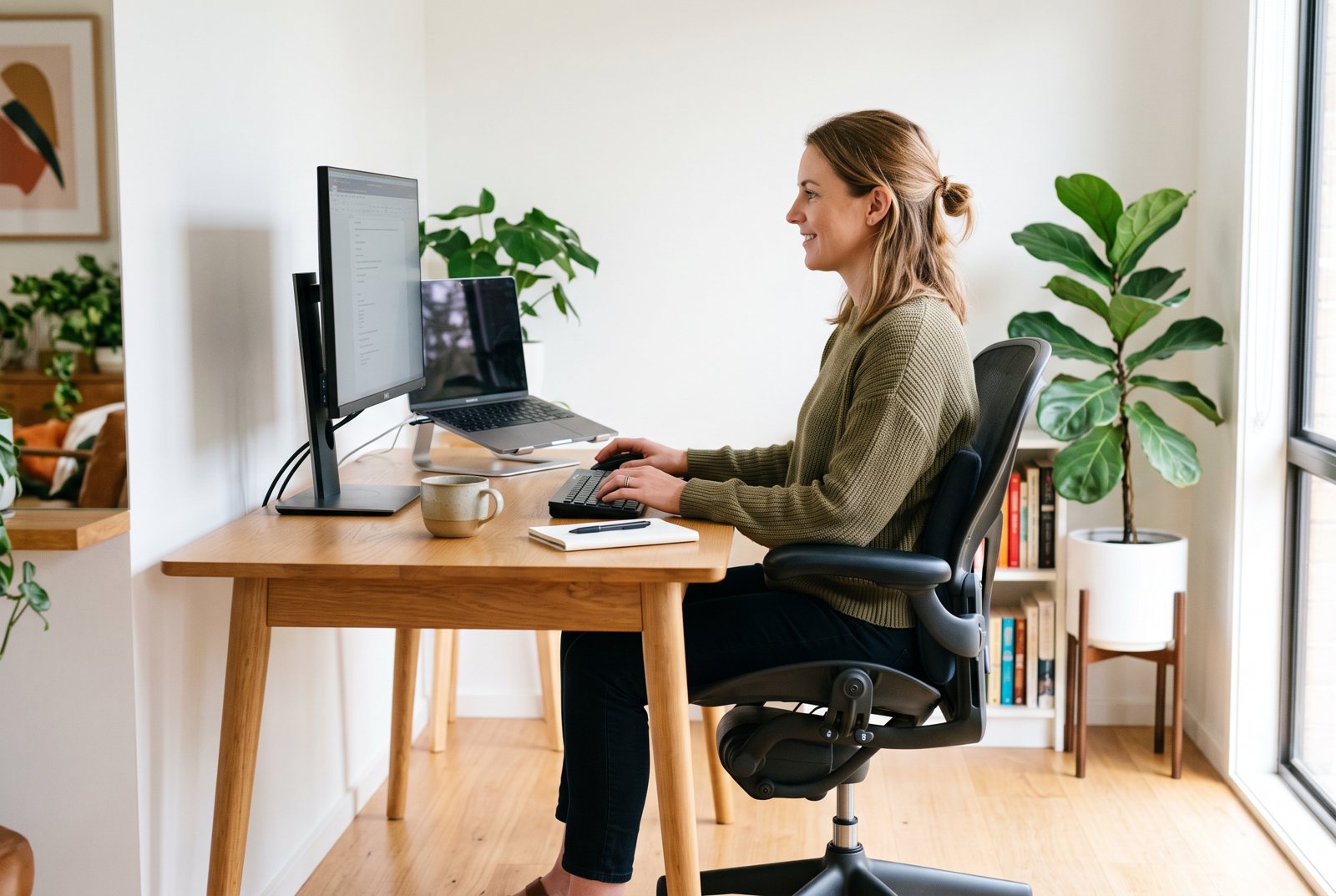
Slouching is not a character flaw. It is what the body does when the muscles that hold you upright get tired, and at a desk they get tired fast because nothing is helping them. So the fix is two-sided. Build the strength with the routine below, and stop asking those muscles to do all the work by setting up the chair and desk properly.
Sit right back in the chair so your lower back is supported in its natural curve. If the chair does not do this, a lumbar roll or cushion in the small of the back does it for a few dollars. Feet flat on the floor or a footrest, knees level with or slightly below the hips, and elbows at about 90 degrees with the shoulders relaxed. Raise the screen so the top third is at eye level; a laptop on its own guarantees a forward head, so use a stand and a separate keyboard. Then set a timer. Standing up for a minute every 30 to 45 minutes does more for posture than any single piece of equipment, because no chair can hold you in a good position for four hours straight.
Which exercises fix bad posture?
These six cover the common patterns and take about ten minutes. Do them daily for the first six weeks, then three or four times a week. Nothing here should hurt; a stretch should feel like a stretch, and a strengthening move should feel like work.
- Chin tucks. Sitting or standing tall, draw the chin straight back as if making a double chin, without tilting the head. Hold for five seconds, release, repeat ten times. This wakes up the deep neck muscles that bring a forward head back over the shoulders.
- Wall angels. Stand against a wall with the lower back, shoulder blades and head touching. Raise the arms to a goalpost position and slowly slide them up and down the wall, keeping the wrists and elbows in contact as far as you can. Ten slow reps. This opens the chest and teaches the shoulder blades to sit down and back.
- Thoracic extension over a rolled towel. Lie on your back with a rolled towel or foam roller across the mid back, hands behind the head, and gently arch backwards over it for a few breaths. Move it up a few centimetres and repeat. This restores the extension the mid back loses from sitting.
- Doorway chest stretch. Forearms on either side of a door frame, elbows at shoulder height, step one foot through until you feel a stretch across the chest. Hold 30 seconds, twice. Tight chest muscles are what pull the shoulders forward in the first place.
- Hip flexor stretch. Half-kneel with one knee on a cushion, tuck the tailbone under and shift the hips forward until the front of the back hip stretches. 30 seconds each side. Tight hip flexors tilt the pelvis forward and over-arch the lower back.
- Glute bridges. Lie on your back, knees bent, feet flat. Squeeze the glutes and lift the hips until the body forms a straight line from shoulders to knees, hold two seconds, lower. Two sets of twelve. Strong glutes hold the pelvis level, which is the base everything above it sits on.
If you already have a back condition, check the list with your physiotherapist first. Our guide to the best exercises for back pain covers the moves that help when pain, rather than posture, is the main problem.
Good posture is not a position you hold. It is what happens on its own when the muscles that keep you upright are strong enough and the set-up around you stops fighting them.
Do posture correctors and braces work?
Posture braces are one of the most searched products in this category, so it is worth being straight about what they do. A brace pulls the shoulders back and makes slumping uncomfortable, which is a useful reminder while you are learning what upright feels like. That is the whole benefit. It does not strengthen anything, and worn for hours every day it can do the opposite, because the muscles it replaces are not being asked to work. The research on braces alone is thin, and physiotherapists generally do not recommend them as a stand-alone fix.
Used well, a brace is a training aid: 20 to 30 minutes at a time, during the part of the day you slump most, for the first few weeks while the exercises take hold. Then it comes off. The same goes for the seat-style correctors, which tilt the pelvis into a better position and are more comfortable to use for longer, but still work best alongside strength work rather than instead of it.
Which posture problem do you have?
| What you notice | Likely pattern | First fix |
|---|---|---|
| Chin juts forward, headaches, tight neck | Forward head position, usually from screens set too low. | Chin tucks daily and raise the screen to eye level. |
| Shoulders roll forward, upper back rounds | Tight chest, weak upper back. | Doorway stretch and wall angels; check the desk height so the shoulders are not hunched. |
| Lower back arches, stomach pushes forward | Anterior pelvic tilt from tight hip flexors and weak glutes. | Hip flexor stretch and glute bridges; avoid sitting for hours without a break. |
| Lower back flat, slumped in the chair | Posterior tilt from sitting back on the tailbone. | Sit back into the chair with a lumbar roll or seat wedge; get up every 30 to 45 minutes. |
| One shoulder or hip higher | Habitual lean, carrying on one side, or a leg length difference. | Swap sides, centre the screen and chair; have it assessed if it does not level out. |
What supports make good posture easier?
Props that make upright the easy option
Lumbar rolls, seat wedges and posture seats hold the pelvis and lower back where they should be so the muscles do not have to.
Equipment does not fix posture, but the right pieces remove the effort of holding it, and that is what makes a new habit stick. A lumbar roll is the cheapest, most portable fix for a slumped lower back and moves between the office chair, the car and the couch. A seat wedge tilts the pelvis forward slightly so the spine stacks on its own, which is why it suits people who sit back on their tailbone. The Curble posture seat does the same job in a single piece and is popular with people who find a wedge too firm.
For the shoulders, a light posture brace is the reminder described above, worth having for the first few weeks if you slump without noticing. At the desk, the chair itself matters most: our guide to the best office chairs for back pain explains what adjustable lumbar support and seat depth do for posture, and kneeling chairs and sit-stand and active seating keep you moving through the day, which is the one thing every posture expert agrees on.
When should you see a professional?
A routine and a better set-up sort out most posture problems, but not all of them. See a doctor or physiotherapist if your posture changed suddenly, if it is painful rather than just stiff, if it keeps getting worse despite the exercises, or if it comes with numbness, weakness, pins and needles, or pain that travels down an arm or leg. A visible curve in a child or teenager, and a new rounding of the upper back in an older adult, should both be assessed rather than trained through.
Frequently Asked Questions
Can you correct years of bad posture?
Yes, in most cases. Posture is a habit held in place by muscles that have adapted to it, and muscles adapt the other way too. Long-standing rounding of the upper back may not straighten completely, and some changes are structural, but the pain, stiffness and the slumped look usually improve a great deal with daily practice and a better set-up. See a physiotherapist if your posture changed suddenly, is painful, or is getting worse.
How long does it take to correct poor posture?
Most people feel a difference within two to three weeks of daily practice and notice a visible change in six to twelve weeks. Habits built over years do not switch off in a weekend, so think in months, not days, and keep the exercises going once posture improves so the gains stay.
How can I stop slouching?
Slouching is what the body does when the muscles that hold you upright get tired, so the fix is two-sided: strengthen those muscles with a few minutes of daily exercise, and stop asking them to work so hard. A chair with lumbar support, a monitor at eye level and a break every 30 to 45 minutes remove most of the reasons to slouch in the first place.
What are four signs of poor posture?
A head that sits forward of the shoulders, shoulders that round forward, a lower back that either flattens or over-arches, and one hip or shoulder sitting higher than the other. Regular headaches, neck and shoulder tightness and a sore lower back after sitting are the symptoms that usually come with them.
Do posture correctors really work?
They work as a reminder, not as a cure. A brace pulls the shoulders back so you notice when you slump, which is useful for short periods while you build strength. Worn for hours every day it can let the muscles it replaces get weaker. Use one for 20 to 30 minutes at a time, and pair it with the exercises above.
Sources
- Healthdirect Australia. How to improve your posture. [healthdirect.gov.au]
- Better Health Channel, Victorian Government. Posture. [betterhealth.vic.gov.au]
- MedlinePlus, US National Library of Medicine. Guide to good posture. [medlineplus.gov]
- Harvard Health Publishing. Is it too late to save your posture? [health.harvard.edu]



 24/7 Office Chairs
 Control Room Chairs
 24/7 Task Chairs
 Ergonomic Office Chairs
 Budget Office Chairs
 Standard Office Chairs
 Premium Office Chairs
 Drafting Chairs
 Heavy Duty & Bariatric Chairs
 Small / Petite Chairs
 Executive Chairs
 Boardroom Chairs
 Executive Chairs – Budget
 Executive Chairs – Premium
 Herman Miller Chairs
 Gaming Chairs
 Hospitality & Cafe Chairs & Stools
 Bar & Cafe Chairs
 Bar Stools
 Production, Lab & Cleanroom Seating
 Lab & Cleanroom Chairs
 Lab & Cleanroom Stools
 ESD Chairs & Stools
 Production Chairs & Stools
 Kids Chairs
 Kneeling Chairs
 Meeting & Conference Room Chairs
 Saddle Chairs
 Saddle Seats With Backs
 Saddle Seats Without Backs
 Saddle Chair Accessories – Bambachs
 Sit Stand & Active Seating
 Active Perching Stools
 Static Perching Stools
 Active Chairs
 Visitor & Waiting Room Chairs
 Sled Base Chairs
 4 Leg Chairs
 Plush & Upholstered Chairs
 Clearance
 Cabinets and Storage
 Book Shelves / Hutches
 Credenzas / Side Tables
 Cupboards
 Drawers / Pedestals
 Desk Accessories
 Anti Fatigue / Active Mats
 Desk Cable Trays / Cable Management
 CPU Holders
 Desk Power Modules and Accessories
 Desk Privacy Screens & Modesty Boards
 Cafe / Hospitality Tables
 Tables for Sitting
 Tables for Standing
 Table Bases
 Kids Desks
 Mobile Carts & Workstations
 Health Care / Hospital Carts
 Home & Office Mobile Units
 Office Acoustic Management
 Office Meeting Booths
 Desks & Tables – Fixed Height
 Rectangle Office Desks & Returns
 Corner Desks & Workstation Pods
 Meeting & Conference Room Tables
 Coffee Tables
 Reception Counters / Areas
 Reception / Admin Counters
 Reception Lounge Seating
 Reception Chairs / Ottomans
 Recliners
 Recliners / Sofas
 Recliners – Zero Gravity
 Massage Chairs & Tables
 Sit Stand Desk Units – Place on existing Desk
 Electric – ‘Place’ On Desk Units
 Manual – ‘Place’ on Desk Units
 Sit Stand Desks – Electric
 Corner (Three Leg) Electric Desks
 Rectangle (Two Leg) Electric Desks
 Sit Stand Desks – Manual
 Single Column Manual Desks
 Rectangle (Two Leg) Manual Desks
 Corner (3 Leg) Manual Desk
 Sit Stand Desk Frames
 Electric Corner (3 Leg) Desk Frames
 Electric Rectangle (2 Leg) Desk Frames
 Table Tops
 Corner Desk Tops
 Rectangle Desk & Table Tops
 Round Cafe, Office & Meeting Room Tops
 Clearance
 Air Cooling and Purification
 Bags & Backpacks
 Desk Lamps
 Document Holders
 Ergonomic Mouse / Mice
 Bluetooth Mouse
 Left Hand / Ambitextrous Mouse
 Roller Bar Mouse
 Track Ball Mouse
 Traditional Style Mouse
 Vertical Mouse
 Ergonomic Keyboards
 Bluetooth Keyboards
 Compact Keyboards
 Full Size Keyboards
 Number Pads
 Split Keyboards
 Floor and Anti Fatigue Mats
 Active Standing Boards
 Anti Fatigue Mats
 Chair Mats
 Foot Rests
 High Rise Foot Rests
 Leg Rests
 Rocking Footrest – Height Adjustable
 Rocking Footrests – No Height Adjustment
 Static Footrests – Height Adjustable
 Static Footrests – No Height Adjustment
 Headsets
 Keyboard Trays
 Monitor, Laptop Risers & Stands
 Laptop Stands
 Monitor Risers
 Tablet & Phone Holders / Stands
 Monitor Arms
 Single Monitor Arms
 Dual Monitor Arms
 Arms For Three Or More Screens
 Wall Mount Monitor Arms
 Monitor Arm Accessories
 Wrist & Forearm Supports
 Forearm Supports
 Clearance
 Pillows
 Sleeping Pillows
 CPAP / Specialty Pillows
 Travel Pillows
 Mattresses
 Mattresses – Hybrid Premium
 Mattresses – Memory Foam Premium
 Mattresses – Home Care Pressure Relieving – Air
 Mattresses – Home Care Pressure Relieving – Foam
 Electric Adjustable Bed Bases
 Two Motor Electric Adjustable Base
 Three and Four Motor Electric Adjustable Base
 Home Care Hi-Lo and Lo-Lo Adjustable Base
 Bed Wedges
 Bedroom Furniture & Accessories
 Bed Mobility / Safety
 Headboards and Surrounds
 Body Pillows / Bed Lounges
 Bolsters / Bed Lumbar Supports
 Leg Wedges / Knee Supports
 Mattress Protectors & Sheets
 Bed Sheets
 Mattress Protectors
 Mattress Toppers
 Specialty Support Pillows
 Clearance
 Braces – Arm
 Forearm & Elbow Braces
 Hand & Wrist Braces
 Braces – Back
 Lower Back / Lumbar Braces
 Pelvic / Sacroilliac Belts
 Thoracic / Posture Braces
 Braces – Leg
 Ankle Braces
 Knee Braces
 Braces – Neck & Shoulder
 Neck Supports
 Shoulder Supports
 Cushions – Lumbar and Back
 Inflatable & Self Inflating Supports
 Lumbar Supports – High Back Premium
 Lumbar Supports – Medium Back
 Smaller Supports and Half Rolls
 Cushions – Sitting
 Active Seat Cushions
 Coccyx Cut Out Cushions
 Donut Seat Cushions
 Inflatable & Self Inflating Seat Cushions
 Swivel Cushions
 Wedge Seat Cushions
 Bathroom Safety
 Bathtup Safety
 Grab Rails
 Bath / Shower Seating
 Toilet Seats & Rails
 Bedroom Safety
 Healthcare Beds
 Mattresses – Pressure Relieving
 Healthcare Furniture
 Lift Chairs
 Pressure Care
 Reaching Aids
 Vehicle & Travel Products
 Outdoors
 Vehicle Aids
 Wheelchairs and Scooters
 Manual Wheelchairs
 Electric Wheelchairs
 Mobility Scooters
 Wheelchair Cushions
 Rollators
 Rollators – 3 Wheel
 Rollators – 4 wheel
 Rollators – Forearm & Knee
 Standing Assistance
 Walking Frames
 Walking Sticks
 Crutches
 Creams & Gels
 Compression Therapy
 Exercise Products
 Balance / Stability / Cooordination
 Exercise Mats
 Training Balls
 Resistance Bands
 Hot & Cold Therapy
 Inversion & Traction
 Inversion / Traction Devices
 Lumbar / Thoracic Stretching
 Neck / Cervical Traction
 Massage Chairs
 Massage Tables
 Massagers / Massage Tools
 Foot Massagers
 Electric Massagers
 Trigger Point / Massage Tools
 Tens & Ems Machines
 Clearance
 Body Cooling Products
 Healthcare Workstations
 Ladders and Safety Equipment
 Safety Stools / Steps
 Manual Handling Equipment
 Lifting & Handling Equipment
 Trolleys and Carts
 Medical Equipment